
Reading Your Groups
Your arrows are leaving you a message. Learn to read group patterns and you'll know what to fix.

Every group you shoot is a diagnostic report, if you know how to read it. The pattern of your arrows on the target tells you far more than a single score ever could — where your form is breaking down, when it breaks, and sometimes exactly which fault to chase. Learning to read groups turns frustration into information, and information is what lets you practise the right thing instead of just shooting more arrows at the same mistake.
Tight but off-centre
If your arrows land in a tight cluster but consistently away from the middle, congratulations — your form is repeatable, and the fix is mostly equipment. A small, consistent group sitting low-left or high-right usually means your sight needs adjusting, not your technique. Move your sight toward the group (a common beginner trick: chase the arrows with the sight) and the cluster will march to the centre. A tight group is a good problem to have.
Scattered everywhere
A wide, random spread is a form problem, not a sight problem. When arrows land high, low, left and right with no pattern, your shot is not repeating — your anchor is drifting, your release varies, or your bow-arm timing is inconsistent. The answer is not to fiddle with the sight but to go back to basics: blank-bale work, anchor checks, and a deliberate shot sequence. Random scatter means the process is unstable, and you fix process with reps, not adjustments.
Patterns with a direction
Directional patterns are the most useful of all, because they point at a specific fault. Arrows stringing left and right (for a right-handed archer) often mean a torquing bow hand or an inconsistent release. A vertical string — arrows high and low — frequently traces back to anchor and draw-length inconsistency, since draw length controls arrow speed and therefore height. Low arrows late in a round often mean fatigue is shortening your draw. Read the direction and you have a strong clue about the cause.
- Tight + off-centre → adjust the sight, trust the form.
- Wide + random → unstable process; rebuild fundamentals.
- Horizontal string → bow-hand torque or release inconsistency.
- Vertical string → anchor and draw-length drift.
Inside NockIQ · AI Video Analyzer
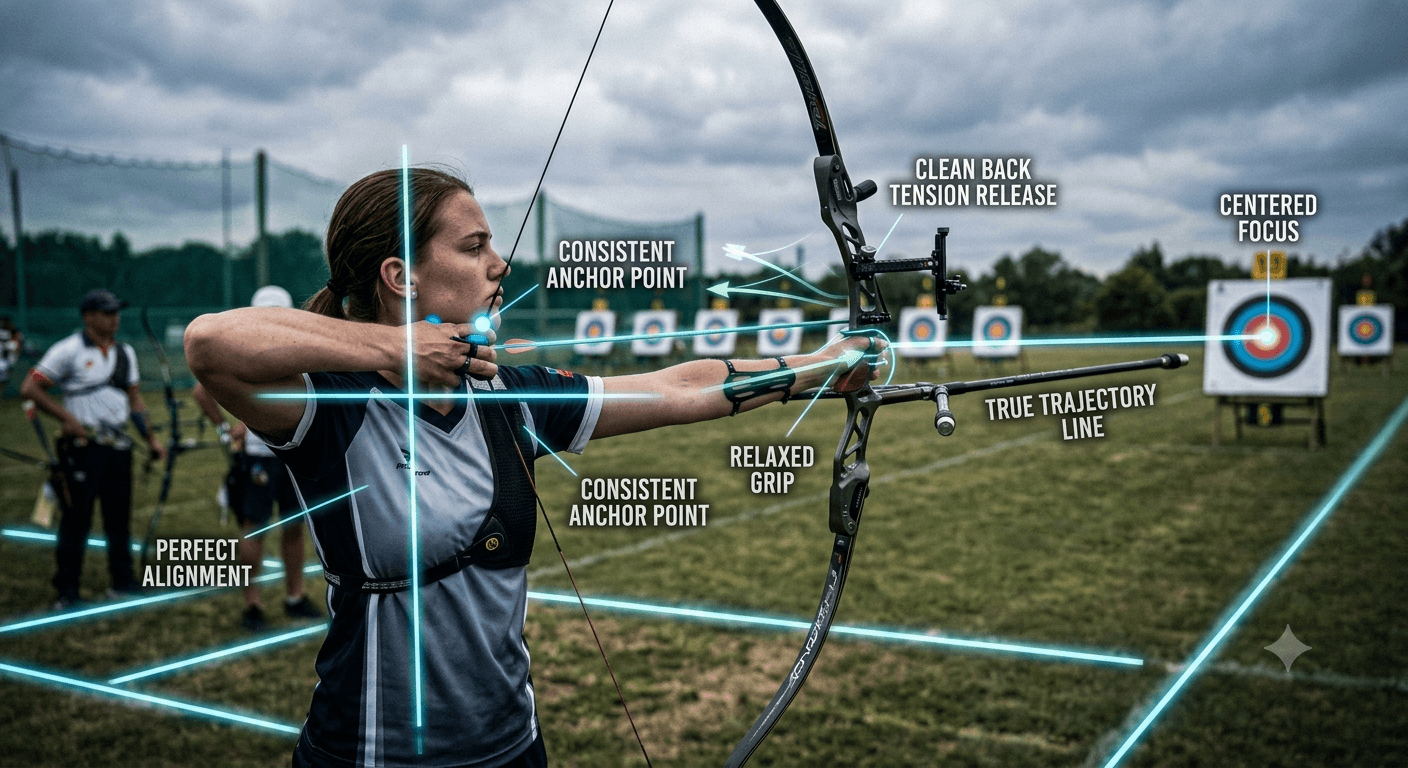
Groups tell you what went wrong; NockIQ's Video Analyzer tells you why — overlaying anchor, draw length and release so a vertical string on the target lines up with the drifting anchor on the screen.
Open AI Video AnalyzerMake a habit of photographing or logging your groups, not just your totals. Over weeks, the patterns repeat, and the repeating pattern is your personal to-do list. The archer who reads groups practises with purpose; the one who only reads scores practises in the dark.
More from the Journal
All articles
Put this into practice.
Every drill, score and replay in one app — built for archers who want to improve on purpose.